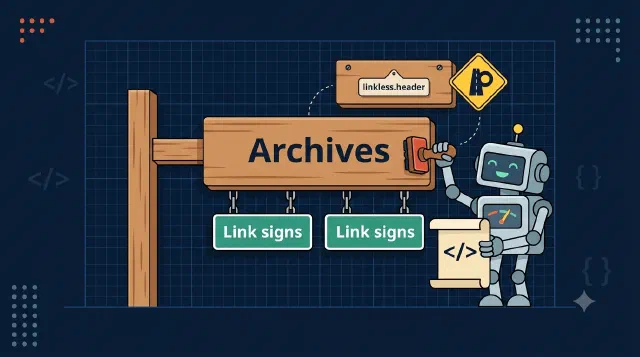
A Link to Nowhere: Nested Navigation Headers in PnP Templates
Learn how to create grouped navigation with non-clickable header labels in a PnP provisioning template using the linkless.header URL convention.
Working with the PnP libraries: template sizing and resilience, authentication, nested navigation, and what is still missing in PnP.Core.
The PnP libraries do an enormous amount of work for you, and then leave you standing at an edge with no obvious way forward. These posts are about those edges.
Template sizing and resilience, because one big provisioning template fails differently from several small ones. Choosing and configuring authentication. Nested navigation with a header that deliberately links nowhere. And the migration story, where PnP.Framework is winding down and PnP.Core does not yet cover everything it replaced.
I try to contribute back rather than only complain: some of what is missing here I have since submitted as pull requests, which are listed on my about page. If you are planning a move to PnP.Core, the honest answer today is that it depends entirely on which CSOM features your provisioning code relies on.
Learn how to create grouped navigation with non-clickable header labels in a PnP provisioning template using the linkless.header URL convention.
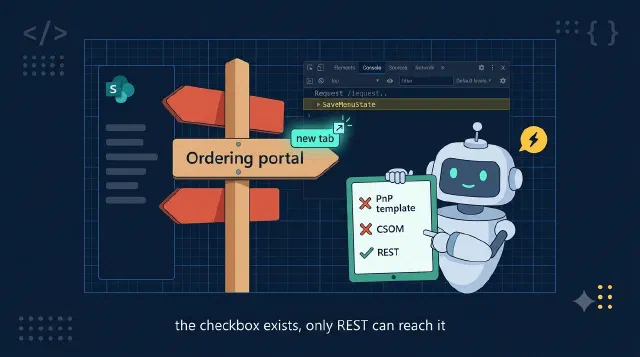
Learn how to set OpenInNewWindow on SharePoint navigation nodes programmatically with the MenuState and SaveMenuState REST endpoints, since PnP templates and CSOM can't.
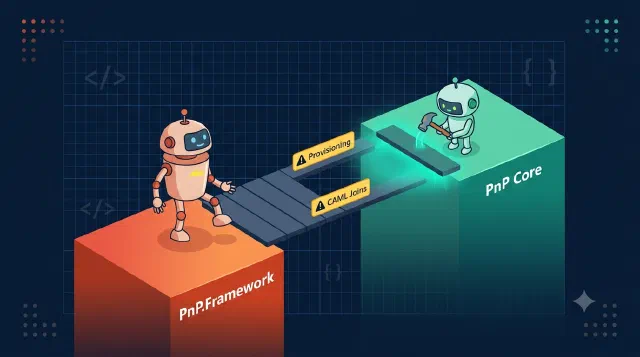
Learn why I'm still on PnP.Framework instead of PnP Core, the two blockers holding the migration back, and what has to land before I make the jump.
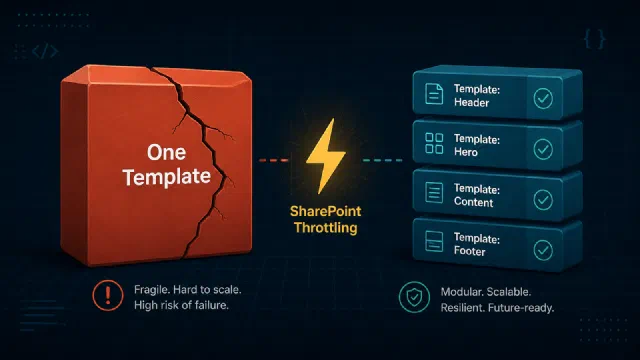
After testing with DevProxy, I found that monolithic PnP templates silently destroy your retry strategy. Here's what I learned.

Learn to authenticate C# applications with PnP.Framework and Azure using certificates in this beginner's guide to app registration and permissions.
No posts match — try another search.